Some links may be affiliate links. I may earn money if you buy something or take an action after clicking one of these links on this site.
Rob Knowlan is a participant in the Amazon Services LLC Associates Program, an affiliate advertising program designed to provide a means for sites to earn advertising fees by advertising and linking to Amazon.com. As an Amazon Associate, I earn from qualifying purchases.
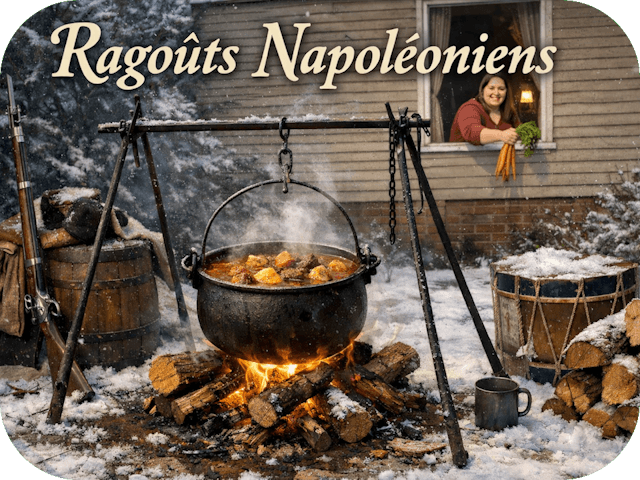
Ragoûts Napoléoniens
Bonjour, mes amis! We are hunkering down for some weather like Napoleon trying to take Moscow. 🏰 Ouille ! So, when the ❄️ winter ❄️ wind 🌬️ blows, we can dig into some sumptuous comfort food inspired by French cuisine.
☃️ Snowmaggedon Again 🥶
The severity of the winter made our situation worse than I had foreseen. ~Napoléon Bonaparte
So, the funny thing about weather is that it’s vaguely predictable, but if you tell people they’re going to be up to their asses in snow and they get a flurry, they’ll get irked.
On the other hand, if you tell people they’re going to get a dusting and they’re buried, they’ll get even more irked.
The important thing, though, is that whether you predict a dusting or a dumptruck-full, people are going to load up on milk, bread and eggs.
It’s a given that predictions of snow leads to mass quantities of French Toast.
Fair enough.
If we’re leaning into French comfort foods, let’s lean in heavily and recognize some glorious stews to enjoy after we’ve had our French Toast for breakfast.
Lunch, supper or lupper, a hearty stew is a great way to keep cozy warm while riding out a big snowstorm or choosing the wrong season to invade Russia.
⚜️ Napoleonic Stew 🍲
In order to fulfill the promise of the section header, I’ve paired classic French stew type foods with some highlights of the Napoleonic Wars.
|
|
|
|
|
|
|
|
|
|
|
|
|
|
|
|
|
|
All’s well that ends well. Maybe not for Napoleon, but Europe felt better with him stashed safely away on a distant island.

🕰️ Time & Patience 😒
The strongest of all warriors are these two — Time and Patience. ~Leo Tolstoy, War and Peace
The nice thing about a whompin’, stompin’ snowstorm 🌨️☃️🌨️ is that it gives me an unimpeachable opportunity to stay inside and get some writing done.
I’ve been working on this series for ages now. Seriously. I was handwriting in a notepad sitting in a minivan outside of Tamaqua High School, waiting for Connor’s Drama Club practices to be over.
In all that time, I’ve been working on my writing, my worldbuilding, my storyline, my characters. All the things that make a story a story have been going through the maturation process.
I’d like to think my writing is at least half as good as I think it is, but I can’t get any substantive feedback from anybody but ChatGPT.
Unfortunately, even that ancillary brain is drastically limited in what it can provide.
I get a lot of quality insights from the review process, but its limitation in holding large chunks of prose without maxing out on tokens leads to incorrect assumptions.
An actual human reader would be able to identify inconsistencies, lost plot threads and other long form issues far better than the current generation of LLM interaction.
But I’m not in a position to engage beta readers yet. I’d like to at least finish a full arc before I do that.
Yes, I’ve heard people say things about catching problems early, but I believe I have enough of a handle on the work to present a coherent volume for readers to really examine.
How?
I listen to my work on my phone.
I’ve got a text-to-speech app that reads the pdf I export from Word, which I export from Scrivener.
I think you can go straight from Scrivener to PDF, but I’m not sure if my TTS app can read the pdf’s that are formatted that way correctly.
In any case, my core concept was a 13 book series with three trilogies and a tetralogy that would encompass both the “Ages of Comics” (Gold/Silver/Bronze/Modern) AND the “Hero’s Journey” in baker’s dozen form.
What do I mean by that?
For one thing, I happen to like the number 13, so I was intentionally structuring it to be a 13 book series.
As far as the Hero’s Journey goes, there’s a version by I forget who at this point where he broke it up into a 12 spoke wheel.
That’s fine, but the “new normal” at the end is treated like a footnote or epilogue sort of dangling denouement. That doesn’t sit well with me.
So, I wanted to have the “new normal” mirror the “status quo” from book 1 of 13.
That’s all great in theory, but I’ve got a LOT OF STORY here.
Doing Book 1 in its entirety would wind up being Sandersonian or Tolstoyesque.
Which is to say, you’d probably throw your back out picking it up to read it.
So, in the interest of not scaring off potential readers, I’m breaking it up into more commercially viable sections of ~150-200K words each.
Despite ending part of the way through what I would have considered Book 1 of 13, it’s sufficiently self-contained to count as a book.
I guess the next hurdle is that atomizing the story this way means that Book 1 / Section 2 will also be sufficiently self-contained to be a book, but it’s not designed to be read out of sequence.
I’m not sure how much of a deal-breaker that is for new readers, but I don’t see a way around it.
My books are not episodic. You really need to know what happened already to get what’s going on in subsequent sections.
I mean, it is what it is. Some people write books that can be taken individually, out of sequence like an Ed McBain mystery.
I plan to write Tales Of Olde Auringia that way and also Far-Flung Reaches, but The Sentinels series runs totally end-to-end.
Well, that’s part of the time and patience aspect of working on a piece of creative writing like this.
I still haven’t done a character count, but I’ve got a pretty significant cast.
Not sure I’ve caught up to Leo Tolstoy’s named character count of ~600, but given the density of my prose and the broadly encompassing scope of Empire City and its surroundings, I may very well approach that figure by the time I get to the actual end of the series.
One of the nice things about ChatGPT is that it can get me stats like that from my sample text.
For instance, having fed it The Sentinels: New Blood and The Sentinels: Price of Engagement (only 24 chapters of ~50) the response with caveats came back as follows:
How the range breaks down conceptually
- ~35–45 core and semi-core characters
These are POV anchors, recurring Sentinels, family members, and institutional figures who meaningfully persist. - ~70–90 recurring secondary characters
Cops, family, coworkers, officials, classmates, media figures — people who appear more than once or carry narrative weight in a scene. - ~70–90 single-appearance named characters
Clerks, officers, criminals, relatives, reporters, neighbors — doing real work, but intentionally transient.
Add those together and you land squarely in the 180–220 zone across the two books combined.
…and that’s technically only a book and a half so far. Mr. McChatsky concedes that these counts are approximate because it’s not doing a hyperfocused determination of name variations (Dave/David, Tim/Timothy, Matt/Matthew, Meirhe/Mary, etc) and it could be collapsing or expanding same-name characters when they’re mentioned individually in various scenes such as Dave Wisler here, Dave Rosen there, etc.
Oh, and don’t tut-tut me about characters with the same name. I grew up Irish Catholic. You cannot throw a water balloon at one of my family functions without hitting several Johns, Patricks, Roberts or Timothys, so if I can cope with more than one John Walsh in the same Christmas party, I feel like you can get over the existence of Dave Wisler, David Harz and Dave Rosen, particularly if I’m not stacking them together in one scene. Sheesh…
Nevertheless, you can see how in ~250K words, I’m populating a city and a loose portion of the Tri-State Area.
Being that there are actually ~8 million people in actual New York City, we’re getting the tiniest sliver of Empire City (fictionalized NYC) even if I do reach Leo’s cast level.
Guess we’ll just have to wait and see how it all turns out.
|
|
|
|
|
That’s all for today. See you back on Wednesday for sledding…