Some links may be affiliate links. I may earn money if you buy something or take an action after clicking one of these links on this site.
Rob Knowlan is a participant in the Amazon Services LLC Associates Program, an affiliate advertising program designed to provide a means for sites to earn advertising fees by advertising and linking to Amazon.com. As an Amazon Associate, I earn from qualifying purchases.
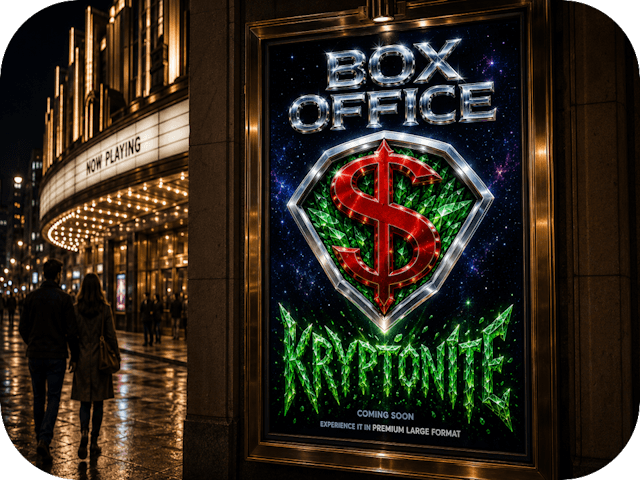
BOX OFFICE KRYPTONITE
Apparently, Kryptonite is a brand of bike locks, but I was looking for something more like this 🔋. In any case, there’s a new superhero movie out this weekend that ought to be good. Is it? Folks, it’s honestly not that hard to do a superhero flick…
🎭 Pathos 😿
The one thing that all superheroes have in common is that they’re champions of the oppressed. ~Denny O’Neil
Pathos is the intentional and, hopefully, artful use of emotion to draw the viewer into a feeling in any given beat of the movie.
Want happy? Rescue a cat from a tree. Deliver a clever one-liner. Smiles and handshakes all around.
Want sad? Graveside gathering in the rain. Comforting a crying person. Show someone feeling lonely and dejected.
Want angry? Put the cat in the tree on purpose and yell at it while you’re doing so. Say something insensitive. Steal someone’s life savings and laugh about it.
There are so many ways to drive emotion across the span of a movie’s run. We have the rhetorical tools to do this.
Even DJs know this. Party song, rowdy song, line dance song, slow dance, ambient music so people can get a drink, party song, slow dance…
Ebb and flow. Control the mood and make it an experience.
Unfortunately, Hollywood is so out of touch with actual humanity that they’ve forgotten how to relate to people who aren’t in their bizarre little bubble.
Whatcha gonna do? 🤷🏻
💩 Bathos 🎭
|
|
|
Sometimes, the pathos can become a bit overwhelming.
Have you destroyed your audience so thoroughly that they can’t go on to the next scene? Have you gotten them so gooshy inside from a kiss scene that they never want to move on?
Have somebody fart.
Bathos is the intentional deflation of the adjoining emotional beat.
It can come with a non sequitur, a mishap, a break in tone or a jump-scare.
Shakespeare had these characters like Falstaff and Bottom who could help you escape the lofty rhetoric of a King of England or Queen of the Fairies just by being idiotic.
Case in point, Nathan Fillion as Guy Gardner in the excerpt below from the most recent Superman movie.
|
|
|
|
The great thing about Green Lantern constructs is that they reflect the personality of the Lantern Corps member.
Hal Jordan and John Stewart do shields, weapons and machines, but we see Guy there making green hands that pimp slap tanks and give the bad guys a giant, glowing green finger 🖕🏼.
That’s bathos.
We were set for an epic, knock-down, drag-out fight for the ages, and he just shot him.
That’s because Spielberg knew how to tell a story, maintain and control energy, leave you feeling good about the whole experience even as they packed the Ark of the Covenant away in a government warehouse for safe keeping. Top men…
|
|
|

👊🏻 …And A Punch In The Face 💥
The function of a superhero is to be optimistic. ~Grant Morrison
Yes, we love an optimistic superhero!!!
Whether it’s the Big Blue Boyscout who can patrol the whole city by himself and still have time to romance Lois Lane or your Friendly Neighborhood Spider-Man cracking wise while he swings around foiling muggings, jewelry store heists and the occasional unhinged supervillain, we love an optimistic superhero.
However, nowadays we need to be all cynical and postmodern.
Our superheroes need to be gritty and damaged and nuanced.
Sure, that’s cool. You elevate the storytelling by adding nuance.
More pathos and a dash of bathos, but don’t forget the punch in the face.
If you’re doing superhero movies, we need some people to get wrecked.
Well, is that me being hypocritical?
How rude.
No, I’m just leaning more into verisimilitude and chronicle-scale drama than cinematic punch-a-thons.
I haven’t had an MCU-grade big fight scene so far, but I have had such a scene recounted to the new team member as a point of institutional shift rather than as a wow-stuff-goes-bang spectacle.
Why?
Because in a movie, wow-stuff-goes-bang plays differently than it does in prose.
Surprisingly, prose fights are desperately boring to read unless you do a LOT of shortcutting, verbal pacing and marginally descriptive vibeyness.
You don’t have the visual of: this guy hits that guy.
You don’t have five backflips and a kick in the head.
You don’t tell every parkour trick and tumble.
I mean, you can, but it’s tedious trying to transcribe a fight scene. You don’t want the play-by-play.
You want the feelings, the experience, the mayhem pushing you around like waves in a tidepool.
You feel like you’re there if there’s less explicit detail.
Impressionistic prose gives the reader room to paint the details for themselves.
Less is more, so let fights be the messy, jumbled little memory glitches that they are and spend more time dealing with the outcome. That’s a better piece of storytelling anyway.
That’s all for today. See you back on Wednesday for 🏊🏻🏊🏻♀️…